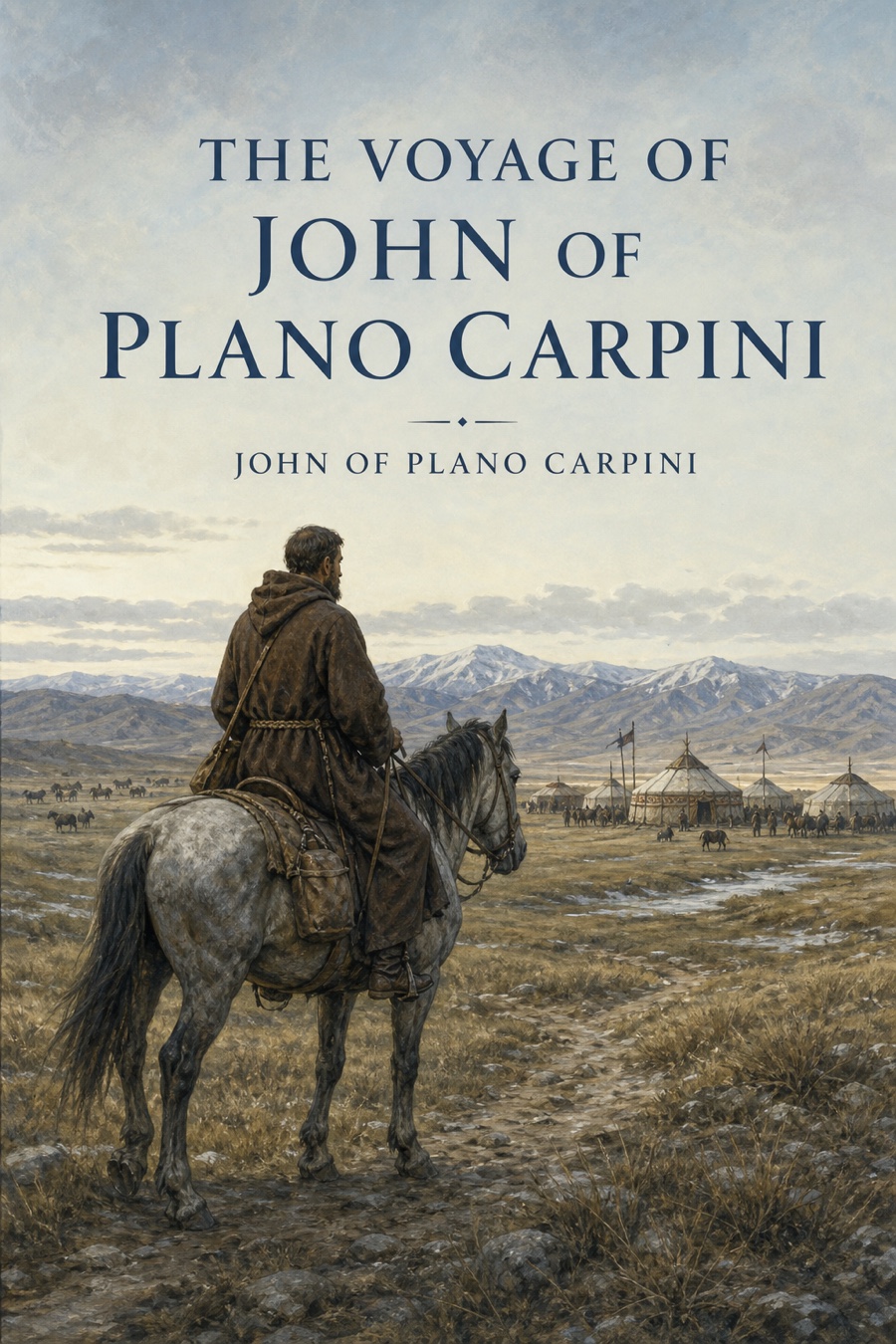
Names and places inThe Voyage of John of Plano Carpini
Who and where you hear about in John of Plano Carpini's account: 4 places, 14 people and 9 peoples, each with the name it goes by today, in the order the narration reaches them.
Places
Kathay
Cathay (North China)In 1 other book ›
Cathay — northern China, lately conquered by the Mongols. Carpini reports its people as skilled craftsmen and 'most excellent' artisans, kindly and civilised, from whom the Mongols drew much of their wealth and arts.
Syra Orda
Sira Ordu (the Yellow Pavilion)
The 'Yellow Camp' — the great ordu of golden-yellow tents, pitched near the imperial residence, where the dukes and tributary princes gathered and Güyük was raised to the throne in Carpini's sight.
Kiow
Kyiv
Kyiv, the chief city of the Rus, which the Mongols besieged, stormed, and depopulated in 1240. Carpini passed its ruins and found the land strewn with skulls and bones.
Bagdat
Baghdad
Baghdad (Carpini's 'Baldach'), seat of the Muslim caliph, then still independent but pressed by the Mongols' southwestern armies and forced to pay tribute — a dozen years before Hülegü sacked it in 1258.
People
the Pope
Innocent IV
Pope Innocent IV, who dispatched Carpini eastward to learn the intentions of the Mongols after their devastation of Hungary and Poland in 1241, and to call them to cease their slaughter of Christians.
Friar Benedict
Benedict of Poland
Benedict of Poland, the Franciscan who travelled with Carpini as his companion and interpreter. He wrote a short account of the journey of his own.
Baatu
Batu KhanБат ханIn 1 other book ›
Batu Khan, son of Jochi and grandson of Genghis — 'richer and mightier' than his brothers — who led the great invasion of Russia and Europe and ruled the western steppe that became the Golden Horde. Carpini had to pass before him on the way to the imperial court.
Zingis
Genghis KhanЧингис хаанIn 7 other books ›
Genghis Khan, founder of the Mongol Empire, from whose sons and grandsons all the ruling dukes Carpini names are descended. Carpini collects an early, half-legendary version of his conquests and laws.
Occoday
Ögedei KhanӨгэдэй хаан
Ögedei Khan, the son whom Genghis set up as his successor — the second Great Khan, under whom the empire drove west into Russia and Europe. Carpini also renders his name 'Ug dai' and 'Octai-Khan.'
Thiaday
ChagataiЦагадай
Chagatai, the second son of Genghis (Carpini also spells him 'Zagathai'), keeper of the Mongol law and lord of the lands of Central Asia that became the Chagatai Khanate.
Cuyne
Güyük KhanГүюг хаан
Güyük Khan, eldest son of Ögedei and the reigning emperor during Carpini's visit. Carpini watched his enthronement in 1246 and carried home his haughty reply to the Pope, demanding the West's submission.
Ordu
Orda KhanОрд хан
Orda, the eldest son of Jochi and elder brother of Batu. Though the senior, he ceded supremacy over the whole Jochid ulus (the Golden Horde) to Batu and took the eastern lands between Lake Balkhash and the Volga, where his line ruled the eastern wing of the Horde. Carpini lists him among the chief princes of the house of Jochi.
Cadan
KadanХадан
Kadan, one of the Mongol princes who led the storm into Poland and Hungary in 1241, winning the battle of Legnica's aftermath. Carpini, who passed through the lands he had wasted, counts him among the dukes who 'were all in Hungary.'
Mengu
Möngke KhanМөнх хаанIn 1 other book ›
Möngke — here a young Mongol prince among the great dukes, son of Tolui and of the powerful Christian lady Sorghaghtani ('Seroctan'). A few years after Carpini left he would become the fourth Great Khan, the one Rubruck later met at Karakorum.
Cyrpodan
A Mongol general operating 'beyond the sea,' making war on the sultans of the Near East — the southwestern command that subdued Georgia, Armenia, and the caliph of Baghdad. He is often identified with the general Chormaqan.
Wasilico
Vasilko Romanovich
Vasilko, a duke of the Rus (of Volhynia), brother of Daniel of Galicia, who received Carpini on the road and briefed him on the Tartars' ways and warcraft.
Corrensa
Corenza
A Mongol duke commanding the westernmost frontier toward Russia, the first of the chiefs Carpini came before. He kept some six thousand men to guard against attack from the west, and demanded gifts before passing the friars on to Batu.
Jeroslaus
Yaroslav II of Vladimir
Yaroslav II, Grand Prince of Vladimir-Suzdal, the senior Russian ruler, who came to the imperial court to do homage and died there — poisoned, it was whispered, at the dowager empress's table — while Carpini was present.
Peoples
Tartar
ТатарIn 4 other books ›
The name Europeans gave the Mongol conquerors, dreaded across Christendom after the invasions of 1241 — partly from a subject tribe, the Tatars, and partly from a grim pun on Tartarus, the classical hell. Carpini's whole mission was to learn this people's intentions.
Saracens
MuslimsIn 1 other book ›
The medieval European term for Muslims. Carpini meets them as subject peoples and traders across the Mongol lands, and notes which conquered nations 'observe the law of Mahomet.'
Solangi
Koreans (Goryeo)Солонгос
The Koreans — the people of Goryeo. The modern Mongolian name for Korea, Солонгос (Solongos), is this very word; and the 'chief of Solangi' whom Carpini saw doing homage at Güyük's enthronement was a Goryeo envoy.
Mongals
MongolsМонголIn 2 other books ›
Carpini's spelling of 'Mongol' — the people's own name, as against the European 'Tartar.' He gives Europe its first ordered description of their homeland, customs, dress, food, warfare, and laws.
Naymani
NaimansНайман
The Naimans, a powerful (and partly Nestorian Christian) tribe of western Mongolia to whom the surrounding peoples once paid tribute, until Genghis broke and absorbed them in his rise to power.
Comani
CumansIn 1 other book ›
The Cumans (Kipchaks), the Turkic nomads of the steppe between the Volga and the Danube, broken and absorbed by the Mongol advance. Their grassland, Comania, formed the long middle stretch of Carpini's road east.
Bastarci
Bashkirs
The Bashkirs, whose country Carpini calls 'greater Hungary' (Magna Hungaria) — believed to be the old homeland from which the Magyars of Hungary had once migrated. The Mongols conquered them on their northern sweep.
Kangittae
Kangly
The Kangly, a Turkic nomad people of the dry steppe east of the Volga, thinly scattered 'owing to a great scarcity of water.' The Mongols crossed their land on the road to and from the imperial court.
Bisermini
Khwarezmians
The Muslim Turks of Khwarezm — 'who speak the Comanian language and observe the law of Mahomet' — whose rich cities (Otrar, Urgench) the Mongols sacked in the campaign that opened their drive west.
Hear every one of them in The Voyage of John of Plano Carpini, narrated end to end on Sonsoo. Listening is invitation only.
Request an invitation to listen