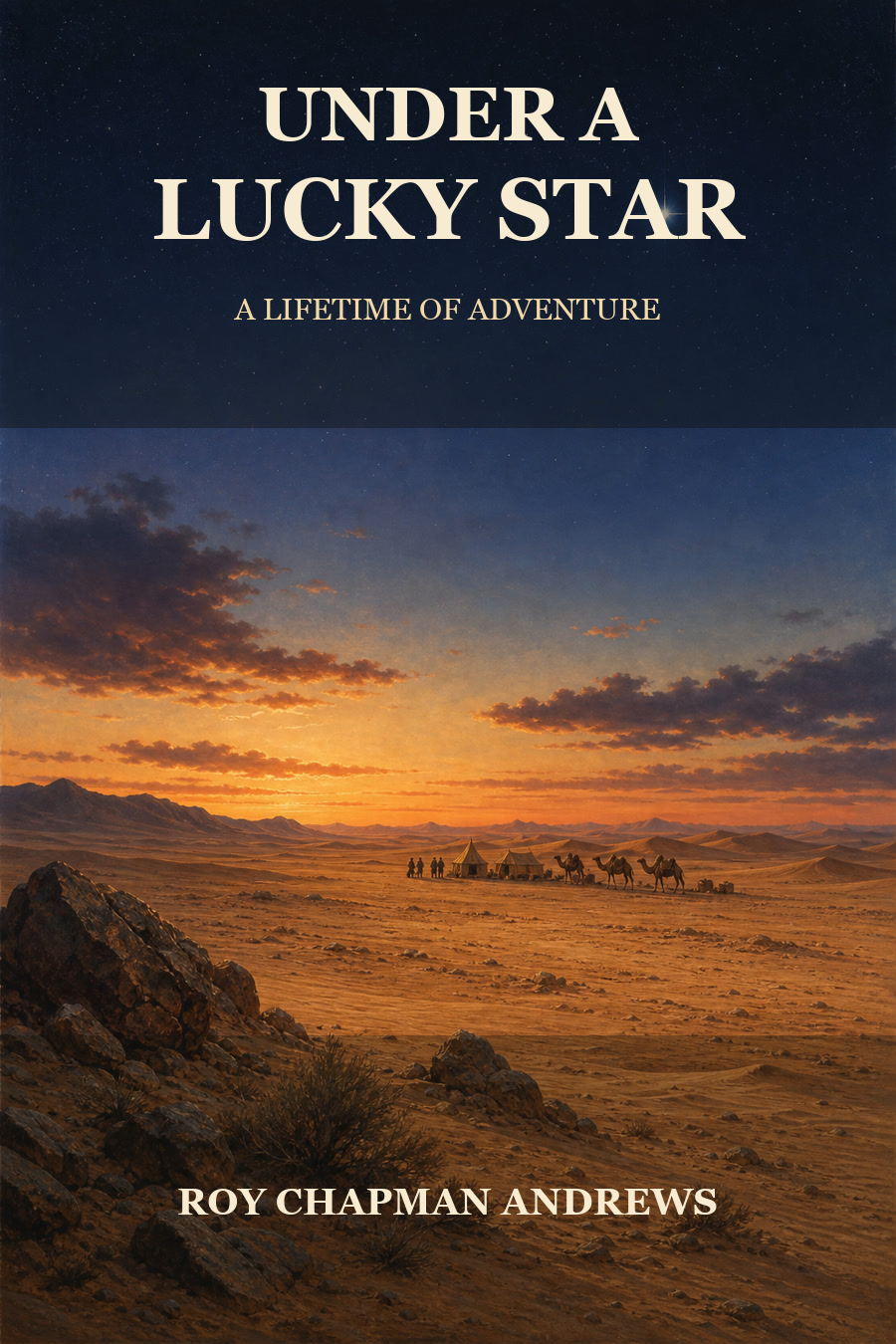
Names and places inUnder a Lucky Star
Who and where you hear about in Roy Chapman Andrews's account: 12 places, 16 people, 1 people and 3 terms, each with the name it goes by today, in the order the narration reaches them.
Places
Long White Mountain
Paektu / Changbai Mountain
The sacred volcano on the Korea–Manchuria frontier, its summit white not with snow but with pumice and cupping a crater lake — the goal of Andrews' 1911–12 Korean expedition, inspired by Younghusband. It is Paektu (Baekdu) Mountain, called Changbai in Chinese.
Peking
BeijingБээжинIn 6 other books ›
The walled imperial capital of China and Andrews' home base for some twenty years — the city of his 'Peking palace' and the outfitting point for every desert season. Now Beijing.
Yunnan
The mountainous, tribal far-southwest of China, where Andrews hunted along the Tibetan and Burmese borders. Its capital, which he calls Yunnan-fu, is the modern Kunming.
Snow Mountain
The great peak above Li-chiang on the Tibetan frontier of Yunnan, rising some twenty thousand feet, where Andrews made what he called the most beautiful camp of his life while hunting goral and serow. It is the Jade Dragon (Yulong) Snow Mountain, above modern Lijiang.
Gobi
The great desert of southern Mongolia and northern China — a waterless gravel plain that proved a fossil treasure-house. Its red beds drew the Central Asiatic Expeditions and made Andrews' name.
Kalgan
ZhangjiakouХаалганIn 5 other books ›
The caravan town at a gate in the Great Wall where the motor caravans were outfitted and the climb onto the Mongolian plateau began. Today it is Zhangjiakou, in Hebei.
Urga
UlaanbaatarӨргөөIn 6 other books ›
The monastic capital of Outer Mongolia, seat of the Living Buddha and of the autonomous Mongol government Andrews dealt with. Renamed Ulaanbaatar ('Red Hero') in 1924.
Tola River
Tuul RiverТуул голIn 3 other books ›
The river that flows past Urga, on whose banks the Mongol princes pitched their summer palaces. It is the Туул гол (Tuul River).
Uliassutai
UliastaiУлиастайIn 5 other books ›
A western Mongolian garrison and trading town under the Qing, on the routes toward the Altai. Today it is Uliastai, capital of Zavkhan Province.
Tsagan Nor
Taatsiin Tsagaan NuurТацын цагаан нуурIn 1 other book ›
The 'White Lake' basin in the Valley of the Lakes, northeast of the Gobi Altai, that served as the expedition's western base. It is Taatsiin Tsagaan Nuur in present-day Bayankhongor; the fossil beds nearby yielded the giant Baluchitherium.
Altai
Алтайн нурууIn 1 other book ›
The mountain system running across western Mongolia; its desert spur, the Gobi Altai, throws up the ranges among which the expedition worked.
Flaming Cliffs
Ulaan EregУлаан ЭрэгIn 1 other book ›
Andrews' name for the wall of wind-carved red sandstone that blazes at sunset — Улаан Эрэг ('the red cliffs'), one feature of the Bayanzag oasis in Ömnögovi. Here in 1923 the party found the first nests of dinosaur eggs and the little dinosaur Protoceratops, the discovery that made the expedition famous.
People
Osborn
Henry Fairfield Osborn, palaeontologist and president of the American Museum of Natural History — Andrews' chief and patron, and the author of the theory that central Asia was the 'mother of the continents,' the cradle from which mammals dispersed. That idea was the premise of the Central Asiatic Expeditions, and Osborn runs through the autobiography as the man who shaped Andrews' museum career.
Morris K. Jesup
Morris K. Jesup, banker, railroad financier, and philanthropist who served as president of the American Museum of Natural History's board of trustees from 1881 until his death in 1908. He was kind to the young Andrews in his first museum days.
J. P. Morgan
J. Pierpont Morgan, the financier and American Museum trustee whose family firm underwrote much of the institution. Andrews recalls Morgan clearing a $125,000 deficit at a single dinner, going round the table naming each man's gift — 'Mr. Morgan didn't ask them, he told them.'
Younghusband
Sir Francis Younghusband, the British soldier-explorer who crossed the Gobi in the 1880s and led the 1904 march to Lhasa. His book on the 'Long White Mountain' fired the young Andrews' wish to explore Korea.
Harry Caldwell
The Reverend Harry R. Caldwell, an American missionary and big-game hunter who spent nineteen years in Fukien, south China. Famous for stalking the legendary 'blue tiger,' he is Andrews' companion in the southern hunting chapters.
Kublai Khan
Хубилай хаанIn 3 other books ›
Genghis Khan's grandson, founder of the Yuan dynasty and Mongol emperor of China — the 'Kubla Khan' of legend, whose memory still clung to the Mongolia Andrews knew.
The Hutukhtu
Bogd KhanБогд хаанIn 4 other books ›
The Jebtsundamba Khutuktu, the 'Living Buddha' of Urga and third figure of the Lama hierarchy after the Dalai and Tashi Lamas. When Mongolia declared its autonomy in 1911 he became its theocratic god-king, the Bogd Khan.
Genghis Khan
Чингис хаанIn 7 other books ›
Founder of the Mongol Empire, whom Andrews invokes as the colossus of Mongolia's heroic past — the conqueror whose horsemen rode from the Gobi to the gates of Europe.
Dalai Lama
Далай ламIn 2 other books ›
The Dalai Lama, spiritual and temporal head of Tibet and first figure of the Lamaist hierarchy. Andrews' contemporary was the thirteenth holder of the office, who had taken refuge at Urga in 1904 during the British invasion of Tibet.
Tashi Lama
Panchen LamaIn 1 other book ›
The Tashi Lama, second figure of the Lamaist hierarchy, seated at Tashilhunpo monastery in Tibet — the dignitary now usually called the Panchen Lama.
Granger
Walter Granger, the expedition's chief palaeontologist and second-in-command — a veteran American Museum fossil hunter who directed the digging at Iren Dabasu, the Flaming Cliffs, and the other great Gobi quarries.
Berkey
Charles P. Berkey, professor of geology at Columbia and the expedition's chief geologist. With Morris he worked out the structure and age of the Gobi formations that gave the fossils their place in time.
Morris
Frederick K. Morris, geologist and Berkey's partner in mapping the rocks of central Asia. The two co-authored the expedition's geological volume.
Shackelford
J. B. Shackelford, the expedition's photographer and cinematographer, whose sharp eye also made him a finder of fossils — it was Shackelford who first spotted the bone-strewn red beds of the Flaming Cliffs.
Olsen
George Olsen, a fossil collector on the staff. At the Flaming Cliffs in 1923 it was Olsen who uncovered the first nest of dinosaur eggs ever recognized by science.
Billie
Wilhelmina Christmas Andrews
Wilhelmina 'Billie' Christmas, whom Andrews married in 1935 — his second wife and the companion of the later chapters, from the Berkshire farm to his last travels. 'Her name, by the way, was Wilhelmina Christmas, but no one ever called her that. She was Billie to all her friends.'
Peoples
Mongols
МонголIn 2 other books ›
The nomad herding people of the steppe, whose horsemanship, hospitality, and Lamaist faith fill Andrews' Mongolian chapters.
Terms
Titanothere
A 'beast of titanic size' — one of a group of large, rhinoceros-like horned mammals (brontotheres) of the early Tertiary. Their discovery in the Gobi helped tie Asia's ancient life to North America's.
Baluchitherium
ParaceratheriumIn 1 other book ›
A gigantic hornless rhinoceros of the Oligocene — the largest land mammal that ever lived, standing some eighteen feet at the shoulder. Granger's party quarried its huge bones near Tsagan Nor; it is now usually called Paraceratherium.
Protoceratops
The 'first horned dinosaur,' a small plant-eating ceratopsian found by the hundreds in the red beds of the Flaming Cliffs. The nests of fossil eggs beside it were the first dinosaur eggs ever recognized by science — though decades later an embryo found inside one showed the eggs belonged not to Protoceratops but to the bird-like Oviraptor.
Hear every one of them in Under a Lucky Star, narrated end to end on Sonsoo. Listening is invitation only.
Request an invitation to listen